
Consumer trust and expectations of the telecommunications sector
RadComms Forum
26 August 2026
Carol Bennett, ACCAN CEO
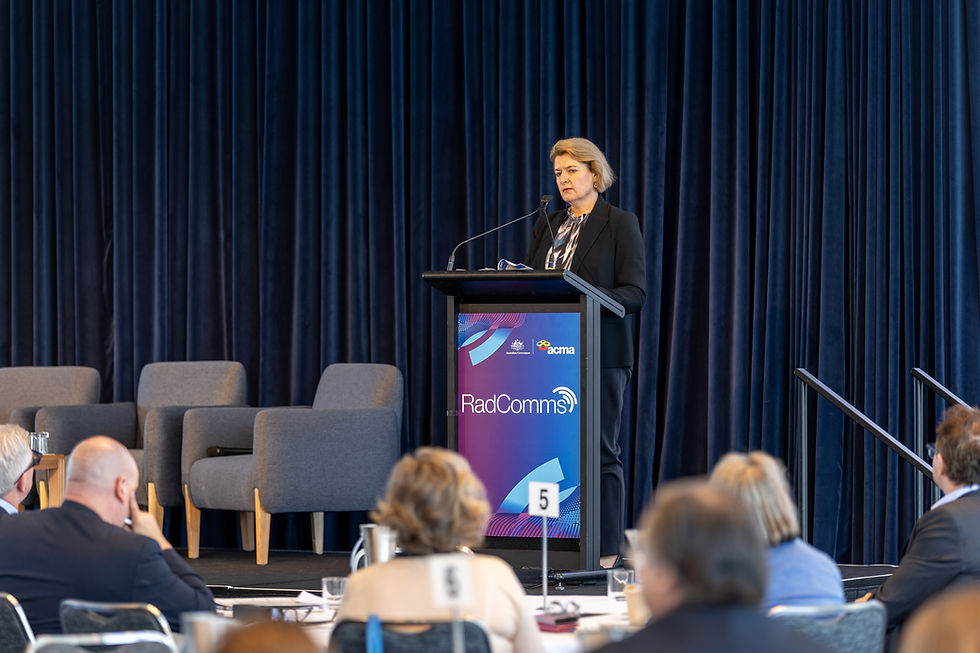
Good morning everyone. Thank you to ACMA for the opportunity to present a consumer perspective to this conference.
I want to acknowledge the Traditional Owners of the land on which we meet today, the Wurundjeri Woi Wurrung people of the Kulin nation and pay my respects to their Elders past, present and emerging. I extend that respect to any Aboriginal and Torres Strait Islander people joining us this morning.
The organisation I lead, the Australian Communications Consumer Action Network (ACCAN), is the national peak body for Australian communications consumers.
At ACCAN, we work to ensure consumers are represented in the debates and discussions that occur in this sector. We advocate for trusted, accessible, inclusive, affordable and available communications and digital services for all Australians.
This morning, my address reflects the current sentiments and preferences of communications consumers in the current telco environment. I aim to cover three things:
I will first talk briefly about how ACCAN works to represent consumer interests in this sector.
I will then discuss our participation in spectrum policy – both what has transpired through the Expiring Spectrum Licenses process over recent times, and the vision we have for the future of Australia mobile connectivity through the efficient allocation of Mobile Satellite Spectrum.
Finally, I will talk about the ongoing, critical issue of consumer confidence in the telco sector – what consumers are telling us and the solutions we can seize, in the short term, to ensure Australians see greater benefits from this sector.
These three issues are connected by a common thread. They are all about whether the decisions being made in this sector are in the best interests of the Australian consumer and are setting consumers up to benefit from the seismic technology changes happening in global telecoms. What they are not about is serving the best interests of the current providers.
First point - how ACCAN represents consumers
Firstly, how we go about our work to advocate for communications consumers.
As a driving principle, ACCAN always remains focused on real outcomes for consumers.
To have a thriving and functional sector - one that is working for industry, consumers and governments - we all need to play our role to the best of our abilities. Some of our agendas align, some don’t. Disagreement and tension is not only to be expected between our different interests, it’s an important aspect of ensuring we get the best outcome for our communities.
ACCAN's driver is to advocate effectively and unequivocally for better consumer outcomes. And of course, industry has different drivers – the interests of their shareholders, boards, market position and reputation.
The regulator has the difficult task of balancing a range of competing interests – supporting a healthy and competitive telecommunications market but also advancing the public interest and protecting consumers.
ACCAN embraces the fact that our role reflects a consumer perspective. We know that can be challenging to industry, government and regulators. None-the-less, we would like to think we are respected for consistently advocating fairly and consistently from a consumer perspective, although some recent actions against ACCAN have not reflected that respect.
We take our role very seriously. To ensure we fully realise our role ACCAN maintains a broad and diverse membership, spanning community organisations, peak bodies, small business representatives, regional advocacy groups, health organisations, special interest groups and disability organisations. We frequently meet with and consult with these groups, and they act as a sounding board for their constituents. Our members inform and advise us in all aspects of our work.
We also conduct in-depth consumer research including our Consumer Sentiment Tracker. This involves a regular, nationally representative survey and focus group polling, working with our research partners, one of Australia’s leading polling companies, Essential Research. This is an important nationally representative view of consumer experiences of, and attitudes towards, the telco sector.
We commission specialist research into critical areas and administer a grants program shaped by our organisation's strategic priorities. Our executive and policy team assess proposals and policy against what we know from our consumer research, the views of our membership, and established policy priorities. This includes an assessment of the telco-policy environment and the broader legal and regulatory structure impacting consumers.
Second point – spectrum management, and the globalisation of telecommunications
Since the beginning of the recent Expiring Spectrum Licences (ESL) process, ACCAN has worked to ensure that significant policy decisions which impact the communications services of millions of Australians now and into the future are made transparently and are informed by consumer perspectives.
I would note that ACCAN is the ONLY consumer representative voice participating in this process which makes our involvement critical given the significant and lasting impact of these decisions on consumers.
ACCAN’s initial view in keeping with international best practice was always that these ESLs should be reallocated via a robust, competitive and transparent auction process as has been the case for previous spectrum allocation decisions. ACMA instead opted to rollover the licenses to incumbent license holders at a price that - in real and nominal terms - was lower than what was previously paid. Adjusted for inflation, the price was substantially lower than what was paid last time (by $1b).
Working with UNSW Business School Professor Richard Holden across Stage 3 and 4 of the ACMA’s consultation, we scrutinised the methodology underpinning the regulators’ proposed pricing. The price moved from an initial proposal of $5.0 to $6.2 billion, up to a final figure of $7.32 billion. That is a substantial difference which suggests the methods used by ACMA to set the initial price were not grounded in complete evidence.
ACCAN asserts that the decision to provide reduce prices to existing providers should come with a requirement for coverage obligations – something that ACCAN’s consumer tracker research indicates Australian consumers strongly support.
ACCAN would also support commitments from telcos to pass through the savings from reduced price spectrum to reduce the retail prices paid by consumers.
Ensuring that spectrum is valued to reflect its efficient price is critical to promoting the long-term interests of consumers. Scarce spectrum assets need to be allocated to their best and highest use today, with pricing that incentivises reallocation to better uses over the duration of the license period.
ACCAN is now interested to see how the spectrum allocation in the 2GHz MSS band progresses. Decisions made now will impact Australian consumers well into the future.
ACMA have expressed a preference to conduct an auction, rather than administratively allocate this band of spectrum. This decision seems at odds with the decision to renew ESLs to the incumbent legacy telcos.
The management of these spectrum assets in the interests of consumers will be critically important to supporting a competitive marketplace for the emerging direct to device services that meet the needs of Australian consumers.
Whatever the outcome, we would like to see conditions for license holders in this band to ensure that spectrum is efficiently utilised so that consumers can access the technology and services they need. Buying spectrum to block emerging competition is not in consumer interests.
The outcomes we seek for the Australian consumer are straightforward: more competition, innovation and new technology to market sooner with choice and downward pressure on prices. Some seem to think ACCAN should not be advocating in this space. We disagree.
For decades this has been a primarily ‘domestic’ consumer industry - mobile networks tied to Australian-based companies, with Australian infrastructure. That era is shifting to a more globalised market, with legacy telcos exposed to international forces in a way they have never been before.
This change comes with great benefits and the promise of far greater coverage. And just as the domestic telco market should be regulated and legislated to maximise consumer benefit and minimise risks, global companies will need to comply with the same requirements.
In 2025, the Deloitte Center for Technology Media and Telecommunications predicted that Direct to Device providers will increasingly pursue a direct-to consumer approach, offering services at lower price points than terrestrial network providers, and “aiming to capture underserved market segments through aggressive pricing and simplified service offerings”[1]
We are seeing this prediction come closer to reality. Some analysts suggest Starlink, through its mobile division, may be shifting toward a strategy that prioritises direct retail contracts with customers, rather than working exclusively through domestic carrier partnerships.[2]
This marks a potential departure from the approach of locking in partnerships with local mobile network operators. The B2B arrangement involving the legacy telcos contracting with satellite providers presents a risk if incumbents are treated differently in the spectrum management process and allowed to lock out new global competitors that can deliver innovation and real value to regional markets. The B2B arrangement also inevitably results in higher prices for Australian consumers who are paying both innovator companies and intermediary companies holding spectrum licenses.
Competition brings potential to drive better outcomes for consumers if we get the settings right to drive D2D technology in Australia.
It is a genuinely exciting moment for consumers. Starlink is the first mover; Amazon Leo is not far behind. And there will be others that challenge existing providers.
Third point – TRUST in telecommunications
Underneath every spectrum decision, every license renewal, every new entrant, sits a single question: do Australians trust that this sector, in all its parts, is working for them? Right now, the evidence says they do not.
In fact, I would suggest to you that consumer trust in the telco sector is at a very low point. Newer services that deliver high-quality reliability and excellent customer service have emerged strongly in our market. Australians are already switching to global satellite services because they are delivering high-quality service, excellent customer service and prices are slowly coming down. (In fact, Starlink is a standout in consumer experience metrics).
Communications should be an essential service and regulated and legislated as such. The limited and loose ‘self-regulatory’ intent of the Telco Act of 1997 has led to significant and repeated failure that has undermined consumer trust.
Roy Morgan's trust and distrust data released last week, again identified telecommunications is Australia's most distrusted industry - for the third-straight quarter with Optus the most distrusted brand at number one and Telstra in 6th place (and that data represents the period before the most recent Telstra nationwide outage in July that affected transport and payment systems and left hundreds of Australians unable to connect to triple zero).
As Roy Morgan made clear, once trust is lost it takes a significant amount of time to rebuild, and that every subsequent failure entrenches an already negative perception of an entity or a sector now treated with suspicion every time that there is an outage or an issue.
Our own research bears this out. Our Consumer Sentiment Tracker, found that even before the September outage, close to half of consumers did not trust their provider to keep costs low, to act in their best interest, or to recommend the plan that actually suited their needs. Four in ten did not trust their provider to properly protect their personal and financial information.
We hear this directly from our members - regional and rural representative groups, disability advocates and first nations communities. These groups experience poor coverage compared to what’s being claimed, ongoing outages and difficulties reaching Triple Zero with no fallback option when there's no neighbour to call.
Our research raised significant concerns about the accuracy of the reported consumer experience of Triple Zero: in our most recent round specifically 8% of Australians report that they or a family member have been unable to reach Triple Zero from a mobile phone in the past 12 months due to an outage. This points to a deep sense of concern among the Australian public about their ability to access Triple Zero when they need it most. One in five (22%) of Australians say their trust in triple zero has declined over the past two years. A failure to protect public safety is a very significant failure that undermines consumer trust scores.
ACCAN acknowledge that some action has been taken to address consumer concerns. The establishment of the Triple Zero Custodian, mandatory outage reporting, progress on consistent coverage maps - these are good initial steps. But initial steps in isolation rebuild little trust, particularly when the industry's instinct, in some cases, is to manage the message rather than fix the fault or invest in reducing the frequency of failures in the first instance.
Trust is not restored by a savvy ad campaign or clever public relations. It is restored the same way it is lost, incident by incident, based on whether the response was honest, timely, and proportionate to what happened. Trust is built through repeated consumer experience. Part of this experience needs to be an industry that offers acknowledgement of the problems, accepts responsibility and takes all reasonable steps to correct it. You can’t hoodwink consumers and tell them what to think - as many industries have already discovered – banking, insurance, aviation and energy have all been down this well-worn path and had to turn back.
As we have witnessed many times in other sectors, when an industry’s self-regulated conduct has fallen short – fit-for-purpose settings need to be established for the benefit of consumers.
ACCAN will continue to advocate for commonsense steps such as the introduction of reliability and performance standards, to bring telcos closer into line with other essential services, as well as and domestic mobile roaming, to make the best use of available coverage to the benefit of all Australians, especially those living in regional, rural and remote areas.
The standard ACCAN will keep measuring this sector against is whether consumers have access to the telecommunications services that they need, at prices that they can afford and receive the high level of customer service that they deserve.
Conclusion
To conclude, as we have seen in other sectors of the economy, consumers must be closely involved and consulted at every stage of policy development to ensure that this essential service meets their needs. Consumers should not be considered an afterthought as ‘end users’. Consumers are the primary reason Telcos exist, and while governments and regulators have multiple drivers, like Telcos, they must ultimately act to serve the interests of consumers.
The consumer experience and outcome is the key touchstone, and consumer trust is the scoreboard that counts most. Every other metric in this sector - profit, revenue, market share - means little. The reality is that if consumer trust continues to be eroded, the legacy telco sector is doomed to failure.
The tools to fix the repeated failures in our telco experiences are largely already on the table and have been actively advocated by ACCAN and others.
Let me finish by again emphasising that at ACCAN we take our role as consumer representatives very seriously, and we will keep advocating on the important issues - on spectrum, on reliability, on the quality and accessibility of services, and on the terms under which new technologies like direct-to-device satellite services enter our market.
ACCAN believe we all have a role to play in ensuring Australia is not left behind in access to telco services, especially as new technologies emerge. We will continue to fulfill our role as consumer advocates, respecting other players in government, the industry and the regulators. We would hope our role is understood and acknowledged, and the respect ACCAN show others is reciprocated.
Thank you for listening and for the opportunity to speak with you today.
[1] Next-gen satellite internet | Deloitte Insights
[2] https://www.ft.com/content/42af0f15-3aa9-49b7-b429-4a39540af03e?syn-25a6b1a6=1